Welcome To Our New Website. As We Fine Tune It, Please Feel Free To Reach Out To Us Directly If You Have Questions or Need Help Placing An Order.

If you’ve ever walked into your grow room expecting to see a flush of beautiful, plump oyster mushrooms or lion’s mane, only to find shriveled, cracked caps or "pins" that simply stopped growing, you know the heartbreak of mushroom dry-back.
Growing mushrooms is part science, part art, and a whole lot of humidity management. In the mushroom world, humidity isn’t just "nice to have"; it’s the breath of life. But here is the frustrating reality: many growers invest in what they think is the right equipment, only to have it fail right when the crop needs it most.
In this guide, we’re going to look at why your current setup might be failing you, the science of the "perfect mist," and how to finally stop the cycle of cracked caps and aborted pins.
In the cultivation community, we talk a lot about "aborts." This happens when a mushroom starts to grow but suddenly gives up and dies. Often, the culprit is a lack of consistent humidity for growing mushrooms.
When the air gets too dry, the delicate outer skin of the mushroom loses moisture faster than the mycelium can pump it in. This leads to scaling those ugly cracks on the caps that make your harvest look unappealing and reduce its shelf life. If the dry-back is severe enough, the mushroom simply shuts down.
Most beginner growers start with cheap ultrasonic humidifiers. They look great at first, but they have a fatal flaw: mushroom spores.
Mushrooms are prolific spore producers. Those tiny particles float through the air and get sucked into the vibrating diaphragms of ultrasonic units. Within weeks, the mineral buildup and spore gunk clog the system, leading to a weak, sputtering mist or a total mechanical failure. If you're constantly replacing $50 units, you aren't saving money; you're killing your margins and your peace of mind.
How do you know if your humidifier is actually doing its job? You don’t need a degree in atmospheric science; you just need your hands.
Try the Finger Test:
Walk into your grow space and run your finger across the floor or the top of your shelving.
● Is it soaking wet?If you feel puddles or heavy droplets, your humidifier is failing.
● Wait, why?Because if the water is on the floor, it isn’t in the air.
Heavy water droplets (anything over 10-20 microns) are too heavy to stay suspended. They fall straight to the ground, leaving your mushrooms thirsty while your floor develops a slip-and-slide risk. You want a "dry" fog, a mist so fine it hangs in the air like a ghostly cloud, wrapping around the mushrooms without soaking them.
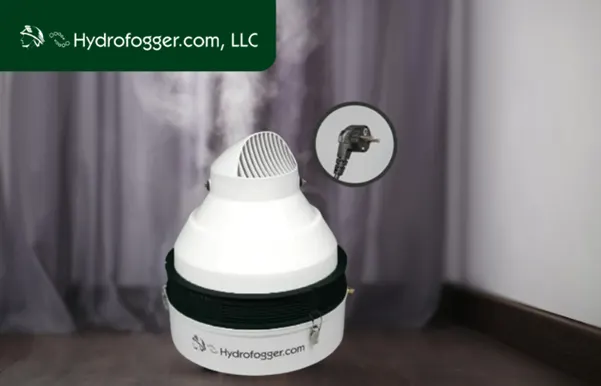
This is where the Hydrofoggerchanges the game. Unlike standard units that rely on vibrating discs, the Hydrofogger uses centrifugal force.
It spins water at high speeds, atomizing it into a consistent 5-micron mist. To give you some perspective, a human hair is about 70 microns wide. At 5 microns, the water is light enough to defy gravity.
Why this matters for your mushrooms:
Expertise and trustworthiness (E-A-T) in mushroom farming come down to balancing two conflicting needs: high humidity and fresh air exchange (FAE).
Most gourmet mushrooms require a Relative Humidity (RH) of 85% to 95%. However, if you hit 90% humidity in a room with "dead air," you are essentially building a playground for Cobweb Mold (Dactylium mildew).
Cobweb mold loves stagnant, damp environments. To prevent it, you need a mushroom humidifierthat works in tandem with your ventilation.
● The Pro Tip:You need to cycle the air in your room several times per hour, but every time you vent out the "old" air, you lose your humidity.
● The Hydrofogger Advantage:Because it produces such a high volume of fine mist, it can recover the humidity levels in your room almost instantly after a fresh air cycle. This keeps your RH stable at 90% without allowing the air to become "heavy" or stagnant.
If you are moving from a hobbyist to a pro, or if you’re just tired of losing crops, you need a tool that matches your ambition. The Hydrofoggeris designed for the rigors of a real grow environment.
● Low Maintenance:No tiny ultrasonic discs to scrub with vinegar every three days.
● Direct Water Connection:Most models can be plumbed directly into a water line, meaning no more lugging 5-gallon jugs across the house at 2 AM.
● Commercial Grade: Durable enough to be used full-time professionally, as it offers the consistency required during high-yield flushes.
● Measure your RH: A good finger sensor should be used, but always support it with the "Finger Test."
● Look at Caps: When scaling or barking sets in, add more mists.
● Airflow is king:Never sacrifice oxygen for humidity. Use a powerful fogger that can keep up with your fans.
● Invest in Quality:A digital humidifieror a centrifugal unit like the Hydrofogger is an investment that pays for itself in one or two successful flushes.
Watching a mushroom crop fail because of equipment failure is a rite of passage for many growers, but it doesn’t have to be your permanent reality. By understanding the relationship between micron size, evaporation, and airflow, you can move away from "troubleshooting" and get back to what you love: harvesting beautiful, gourmet fungi.
Stop fighting with your equipment. If you're ready to see the difference a professional-grade 5-micron mist can make,check out our range of Hydrofoggers hereand give your mushrooms the environment they deserve.
You can try, but you’ll likely run into two problems: clogging and capacity. Household units aren't built to handle the high-spore environment of a grow room. The spores quickly gum up the internal parts. Furthermore, most home units don't have the power to maintain 90% humidity in a space with constant fresh air exchange.
Cobweb mold loves stagnant, humid air. The solution isn't to lower the humidity but to increase Fresh Air Exchange (FAE). You need a system like the Hydrofogger that can pump out massive amounts of fine mist to "keep up" with your exhaust fans. This allows you to cycle in fresh oxygen without bottoming out your humidity levels.
Aborts often happen due to sudden environmental swings. If your digital humidifier runs out of water or your fogger fails for just a few hours, the pins lose their moisture and die. Consistency is the "secret sauce" of mushroom farming; a reliable, plumbed-in humidification system prevents these costly heartbreaks.
A 5-micron droplet is so light that it behaves like a gas. It floats and fills the entire room, ensuring every mushroom, even those in the corners, gets equal moisture. Standard sprayers create large droplets that fall and soak the substrate, which can lead to bacterial blotch and rot.
Maintenance is simple: keep the water source clean and occasionally wipe down the centrifugal disc to remove any stray mushroom spores or dust. Unlike ultrasonic units that require frequent, delicate cleaning of the "pucks," the Hydrofogger is built for the "set it and forget it" lifestyle of a busy grower.


Stay updated with the latest news, tips, and exclusive offers by subscribing to our newsletter! Join our community to receive valuable insights directly in your inbox. Don't miss out—sign up today and enhance your experience with us!